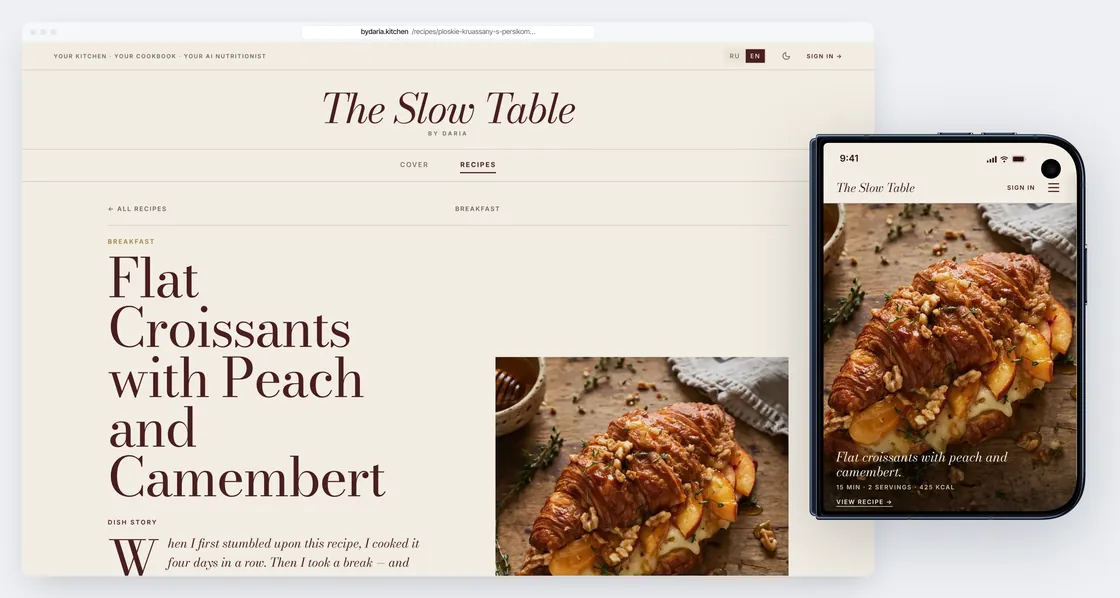
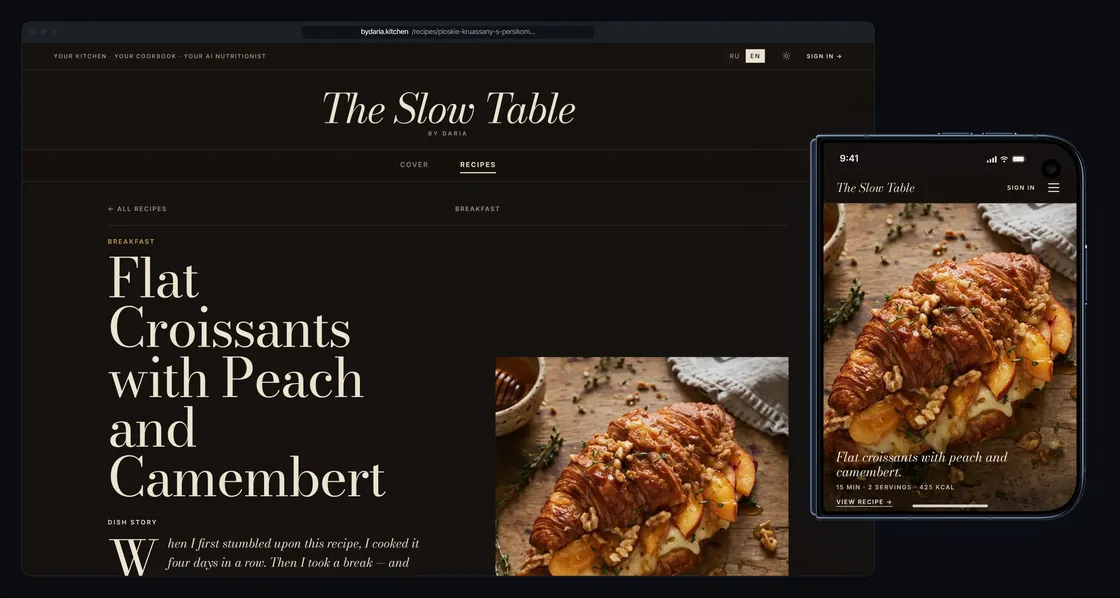
Context
I had three reasons. I wanted my family's best recipes in one place, to pass on and swap with friends. I cook a lot, so I wanted one reliable book of what we love most. And I wanted to build a product from scratch and go through every business stage myself.
From rules to code
Before screens, I wrote the rules. There are three kinds of recipes: the author's catalog, your private book, and recipes you saved. Your book is visible only to you, and the database enforces it.
Plans and limits are rules too: what Free allows, what Premium unlocks, and AI features paid with credits. A payment updates your plan automatically through Stripe webhooks.
The hardest part: how do people keep recipes?
Libraries, keys and integrations were hard. The harder question was how people actually keep a cookbook, and what structure they have in their heads. The goal: open the book, add a recipe, get back to your day.
I ran usability sessions in two rounds. What they changed:
- Privacy didn't show.One participant thought her book was shared with friends. The code was right; the interface didn't say it. I added a clear line: only you see these recipes.
“Like a social network.”
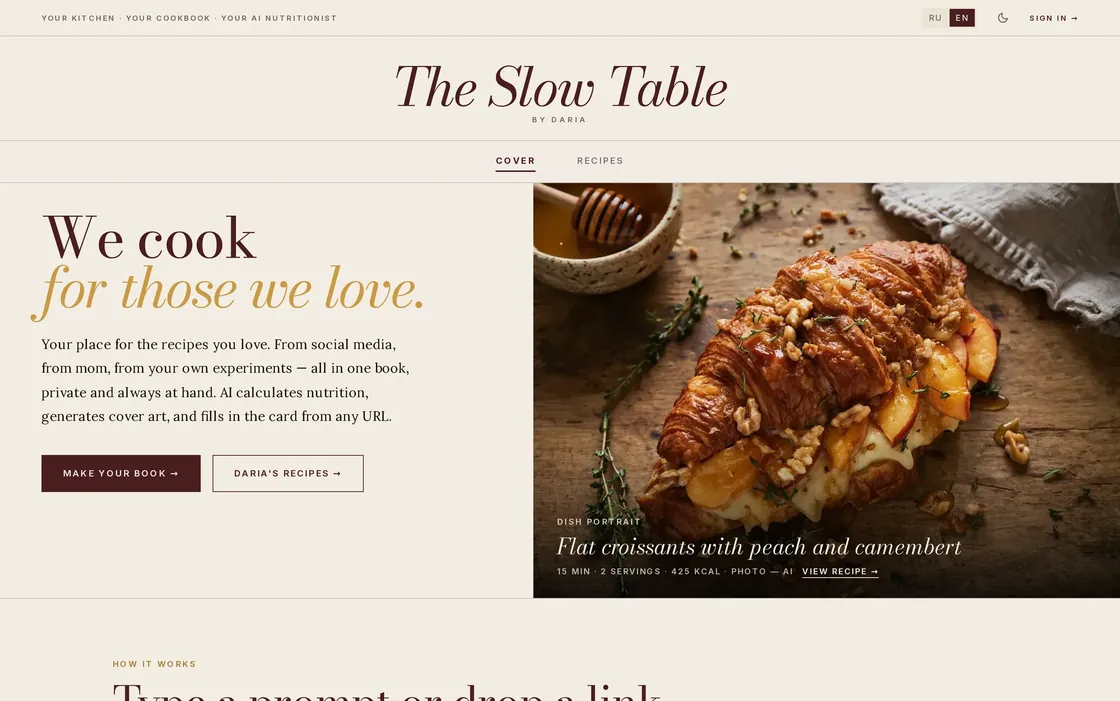
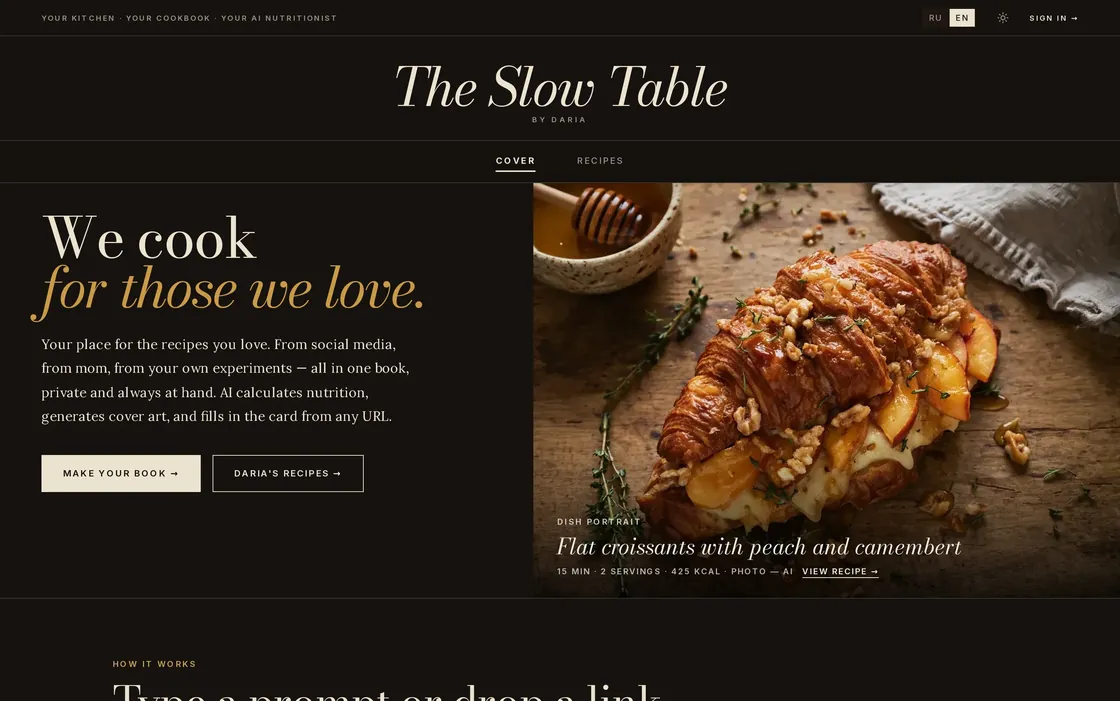
- Too much text.My first version looked like an old American newspaper — columns, footnotes, newspaper words, Roman numerals. Beautiful, unique, and it didn't work as a digital product. I kept the style and removed its vocabulary. I had overdone the beauty.
“So much text for a design — and none of it clickable.”
- Nutrition wasn't the wow.Two of three early participants cared more about photos and recipes. I kept it, but not as the only hook.
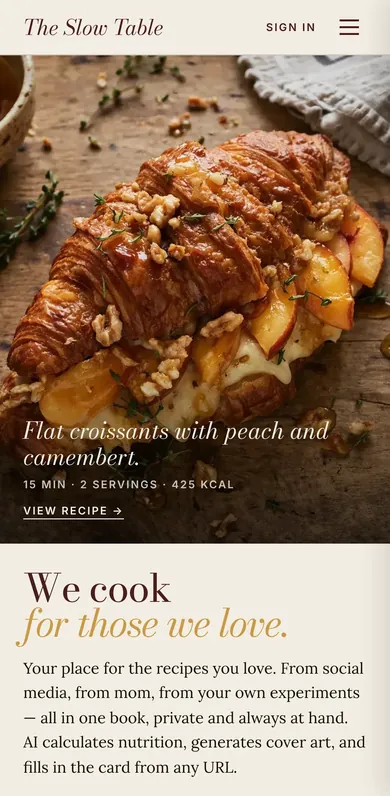
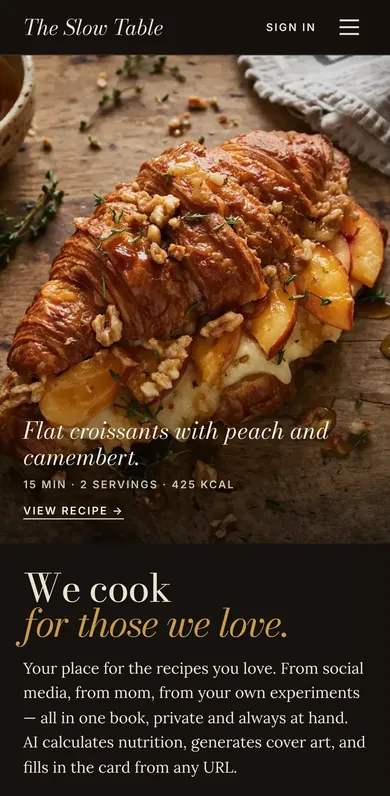
- Mobile showed what desktop didn't.With a real card, one participant found there was no way to cancel a subscription yourself. For now, I handle cancellations by email the same day; a self-serve button is on the list.
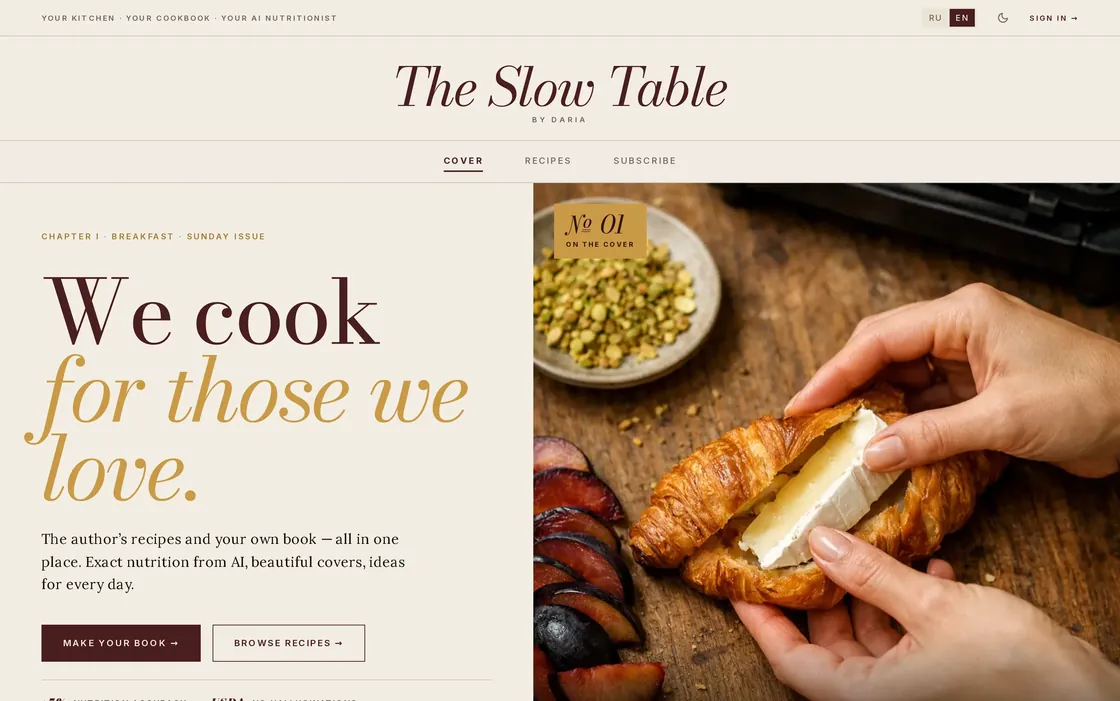
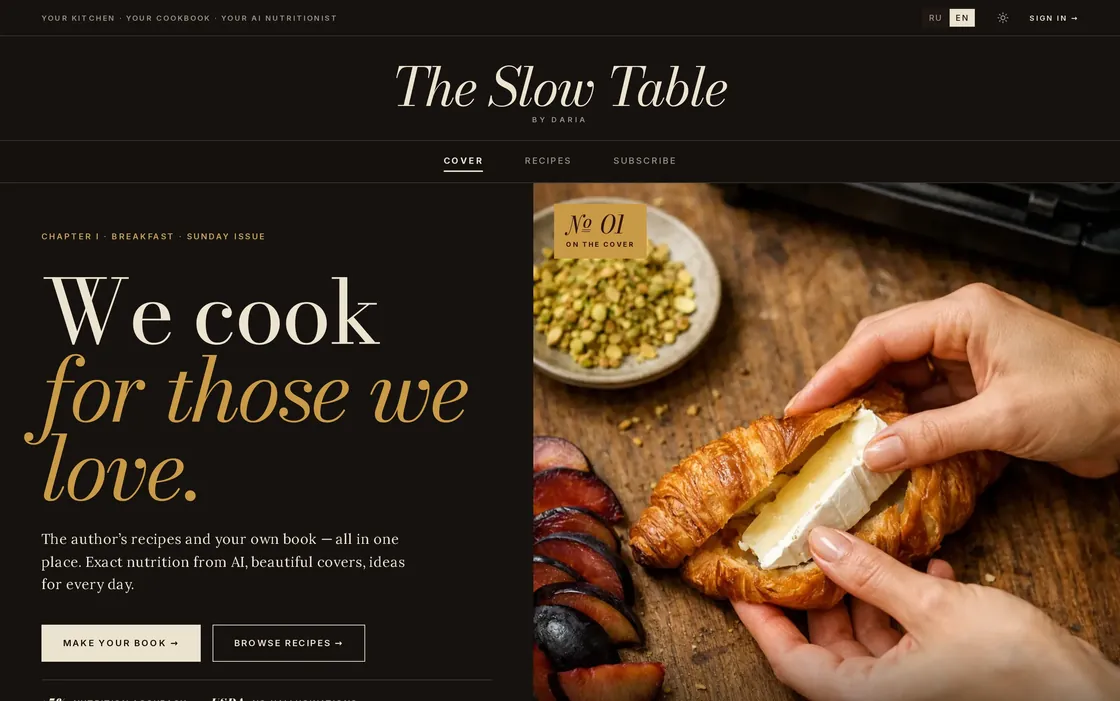
Anatomy of a decision
Free limit: 15 → 7 recipes
Trade-off: fewer free recipes, but limits and credits keep the product at least slightly profitable.
Pricing people can read
Two questions: what you subscribe to, and what you use up. Premium removes limits; Lifetime is Premium forever plus 10 AI covers; covers come in packs, because each image costs money. “Covers from €4.90” confused 4 out of 4 participants — still the first thing I want to fix.
Paddle → Stripe
Paddle handles EU VAT for you; Stripe was much simpler to integrate. Trade-off: tax compliance stays with me. I accepted it for a faster launch, and checked a real payment and payout to a Czech card.
Working with AI
AI in the product: honest numbers. Ask a model for a recipe's nutrition and you get the most likely answer, not the true one. So the model only reads the ingredients. Real data from USDA FoodData Central (opens in a new tab) and plain code do the maths. If an ingredient isn't found, the user enters values by hand or asks AI to estimate — and the interface says it's an AI estimate.
AI in my process. Claude wrote the code; I made the decisions. Inside the product I used small models where they fit: gpt-4o-mini to parse recipes, Gemini 2.5 Flash to translate, Imagen 4 Ultra for covers.
- My questionHow generous should the free plan be?
- Claude's answerA very small free tier, to push people to upgrade.
- My decisionPeople need room to try a cookbook first: 15 recipes, then 7 after testing and the maths on token costs.
Result
In the first two months, 14 people signed up and 5 started their own book. Then I tested paid ads to find out what grows it.
Meta ads, 505 CZK, 6 days: 878 visits, 2 sign-ups, 0 started a book. 94% of visitors never opened a recipe — the first screen was losing them. 80% of the budget went to Georgia, where views were cheap. Israel and Czechia had the best click-through and almost no budget.
Numbers as of 3 September 2026.
What grew on its own
One recipe became the most-visited page after the homepage: “Pork ribs like at Frank by Basta”. Frank by Basta is a well-known restaurant, famous for its ribs. I wrote my home version with the story of how I first tried them there — and put the restaurant's name in the title.
Visitors a day to one recipe page · August–October 2026
Why it worked — my hypothesis, not yet confirmed in Yandex Webmaster. People who have eaten at the restaurant search for a copycat recipe. That query has real demand and almost no competition, unlike “pork ribs in the oven”. The page also has Recipe structured data, which Yandex shows as a rich result. About 40% of readers are on desktop and 86% leave without opening another page — it looks like search.
Wrong audience for revenue
About half of these readers are in Russia and can't pay for a subscription. It proves the content approach, not the monetization.
Google can't see the English version
The language switches with a cookie, not a URL. For search engines the English pages don't exist — so the audience that can pay can't find them.
Vercel Analytics, 1 August – 31 October 2026.
Reflection
Building the product was the easy part. Distribution was the bottleneck.
Ads bought visits but almost no users. The one channel that grew on its own came from content people were already searching for. I also learned to run Meta ads — hours of audiences, locations and tests.
Next time: make the first screen work for new visitors before paying for ads, and choose countries where people can pay, not where clicks are cheap.
Next for The Slow Table: separate URLs for each language, so the English version can be found in search.
See it live
Cook from the book
Open a recipe, start your own book, try the free plan.
bydaria.kitchen (opens in a new tab)