Context
I wanted to eat and train toward my goals without the load of planning and counting, and to fit it to my schedule and tastes. The apps I tried leave the planning to you, and you can't change how they work.
Since AI started moving fast, I've learned it by building it into my own work. This project is my answer: a crew of AI agents shaped around me.
A chat with AI can plan, but it can't be trusted to count. Ask a model for a dish's nutrition and you get a likely number, not a checked one. In The Slow Table I solved this for recipes. Here the same rule had to hold for a whole system.
It's a personal tool, not medical advice: it follows the targets my nutritionist set and never changes them.
Working with AI
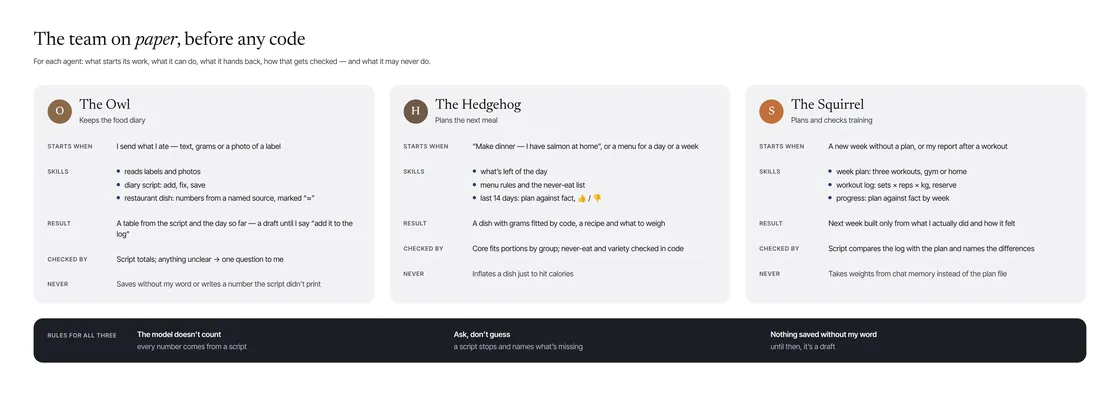
Before anything was built, I drew the system on paper: which agent, what it does, what skills it needs, what starts its work, what the result is and how it gets checked. The more exactly I describe it, the better the result. When I don't know if something is possible, I work out the architecture with the agent; the agents even helped write their own skills.
I give tasks by voice, through Wispr Flow, and the agent takes the technical part. The interface is the easy part. The hard part is deciding what the team is and how it should work.
Claude wrote the scripts, the tracker and the bot; I designed the roles, the rules, the protocols and the data model. The instructions for the agents are themselves a design artifact: who does what, when to ask, when to save, and when not to act.
From rules to code
Two touchpoints, three roles. In Claude Cowork on my Mac, I talk to three agents. The Owl keeps the food diary. The Hedgehog plans a dish or a menu for the rest of the day. The Squirrel handles training and progress. On my phone, a Telegram bot, Slow Table Menu, plans a dish, a day or a week and fills a Rohlík shopping cart. A Hedgehog menu goes to the bot only when I ask. When something is off, I improve just that one role.
Scripts do the calculations. The agents name products, grams and exercises, and copy numbers from food labels. For a restaurant dish, the agent finds the numbers online, names the source and marks them “≈”. Every calculation, from daily totals to matching a workout to the plan, comes from Python scripts. An agent may not write a number in the chat that a script didn't print.
Ask, don't guess. If a script can't do something safely, it stops and says what's missing. The agent asks me exactly that question and nothing else. Nothing is saved until I say “add it to the log”: until then, it's a draft I can correct.
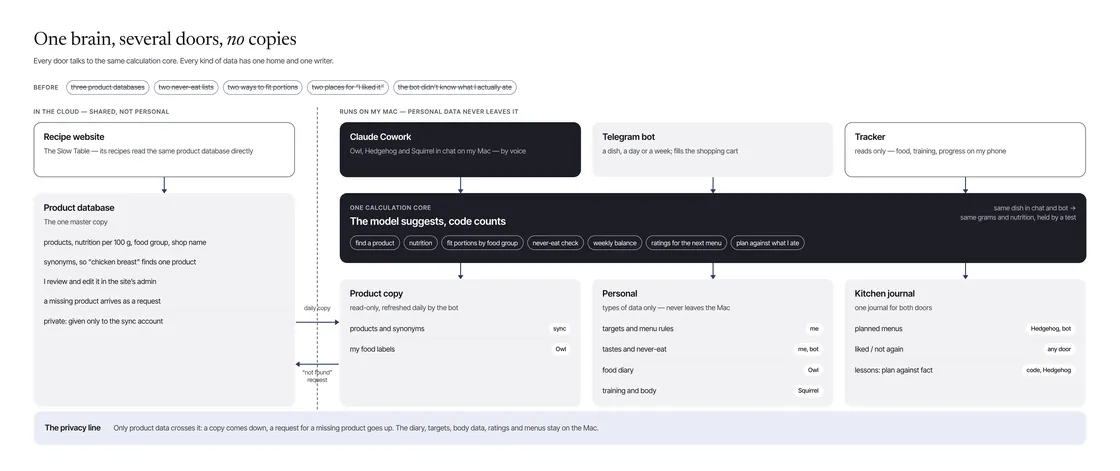
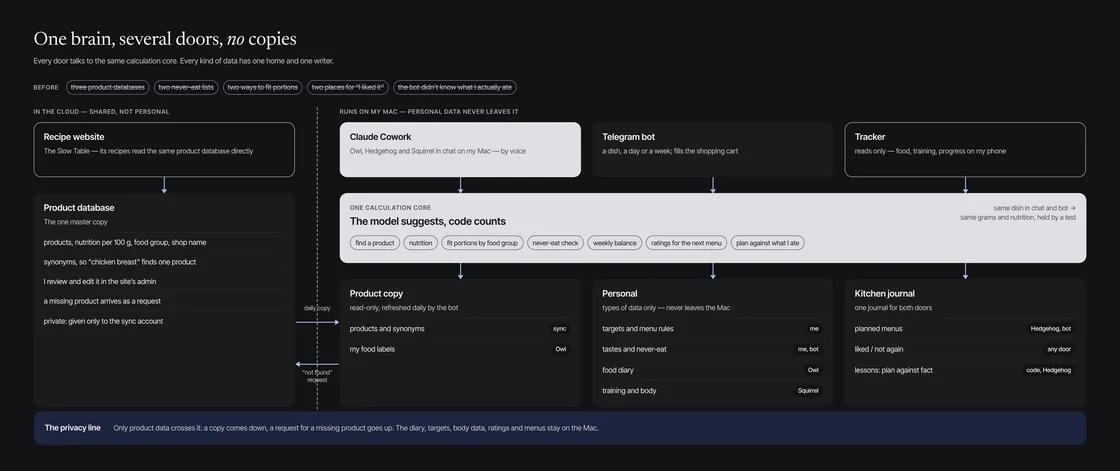
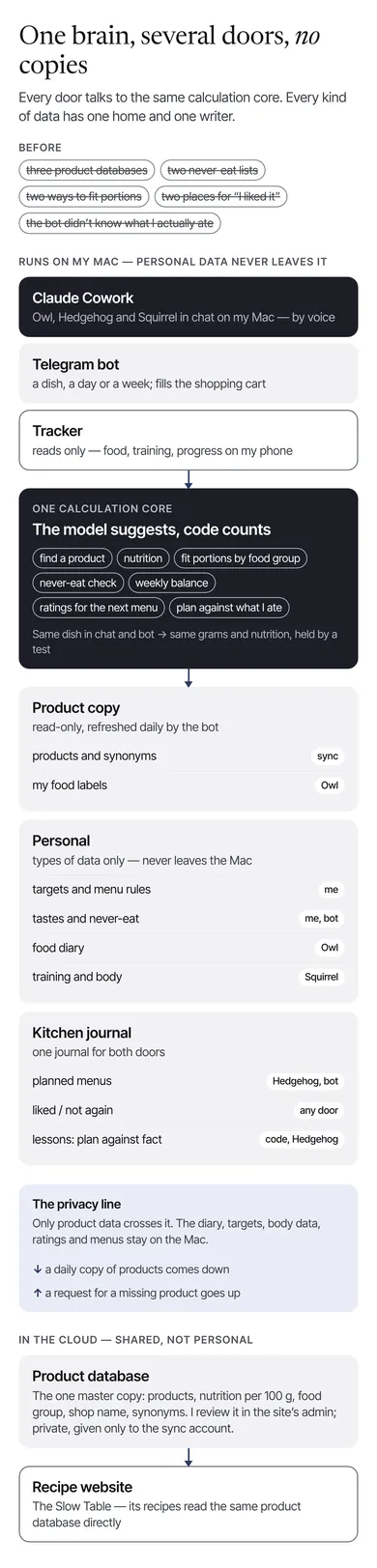
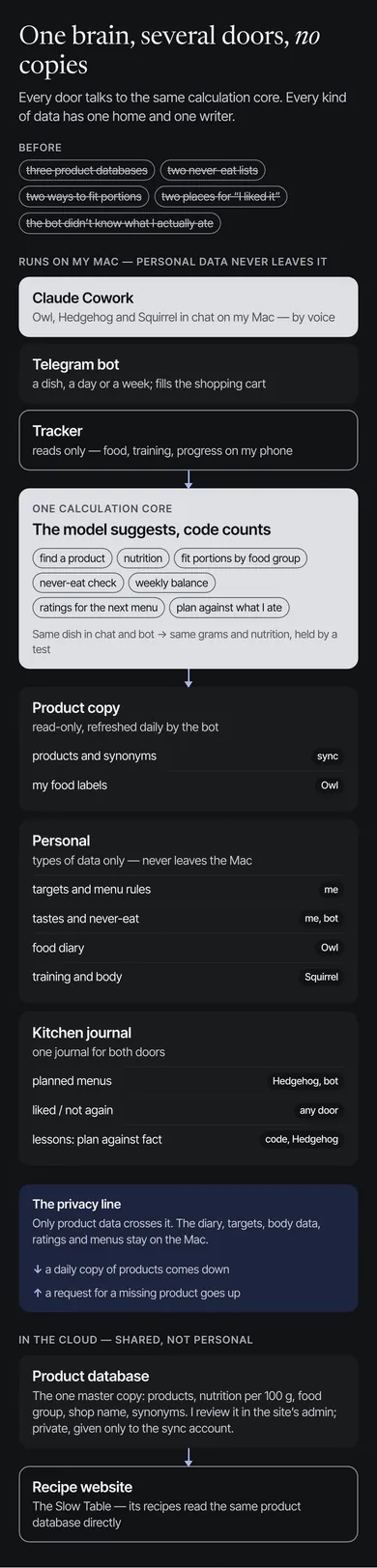
One source of truth. Every kind of data has one home and one writer. The chat agents, the bot and my recipe website count with the same product database. The menu rules live in one file. Both the Hedgehog and the bot read it, so one edit changes how both behave. My nutritionist's advice became rules there: swaps, how to stay full, what to keep at home, how to batch-cook for the week. Each rule has a code, like a business rule: for example, variety is counted by the main protein, so two different dishes with chicken still count as chicken twice.
The hardest part: copies
The agents arrived one at a time, and each brought its own copy of what it knew. After a month I had three product databases, two never-eat lists and two ways to fit a portion, and the bot didn't know what I'd actually eaten. Bringing them together showed me what I should have drawn first: where each kind of data lives, who writes it and who only reads it. Personal data stays on my Mac, and only product data goes to the cloud. A new door now reads the core instead of copying it.
Anatomy of a decision
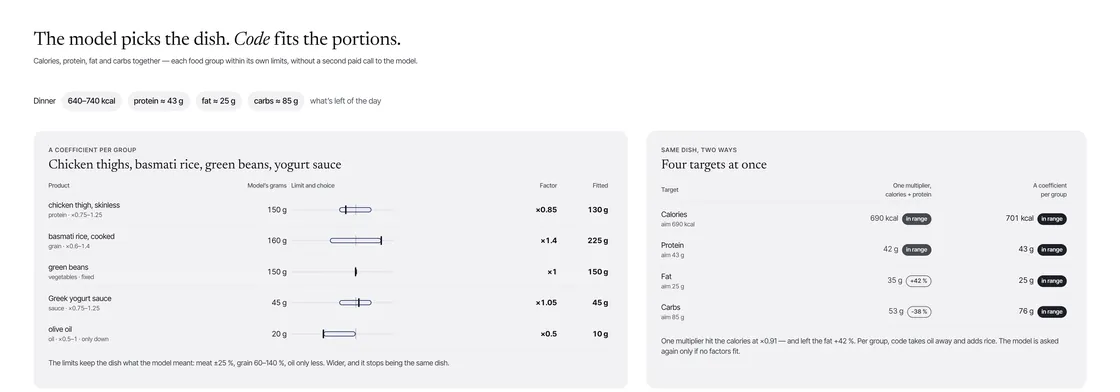
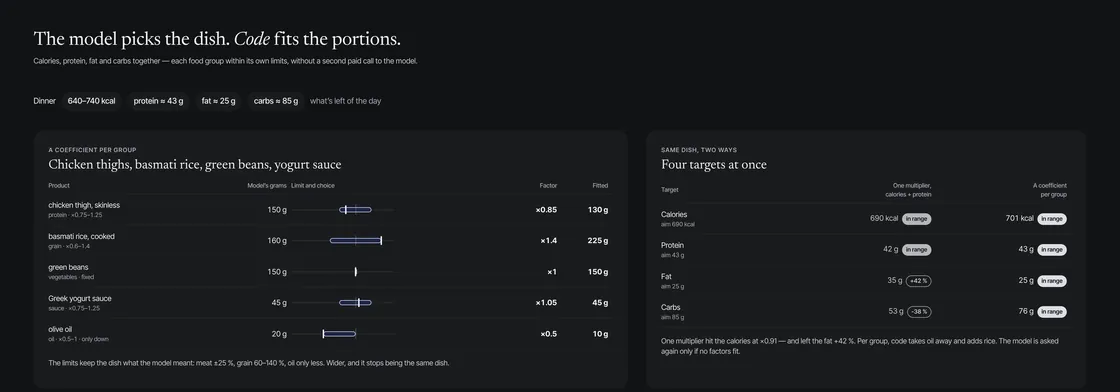
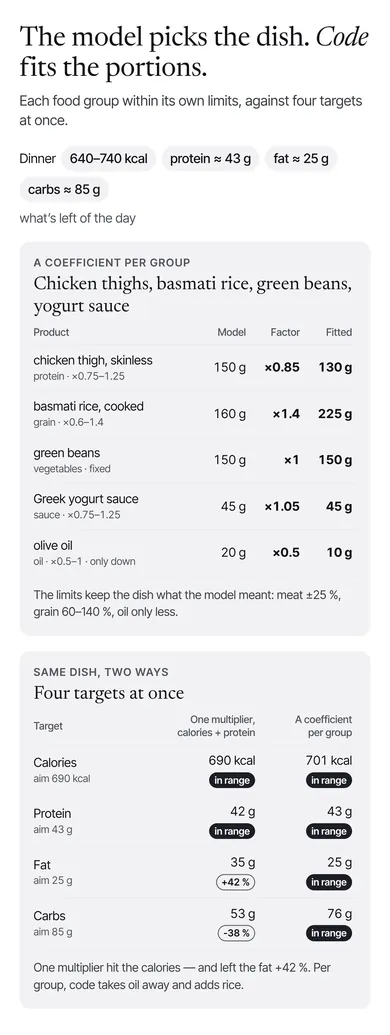
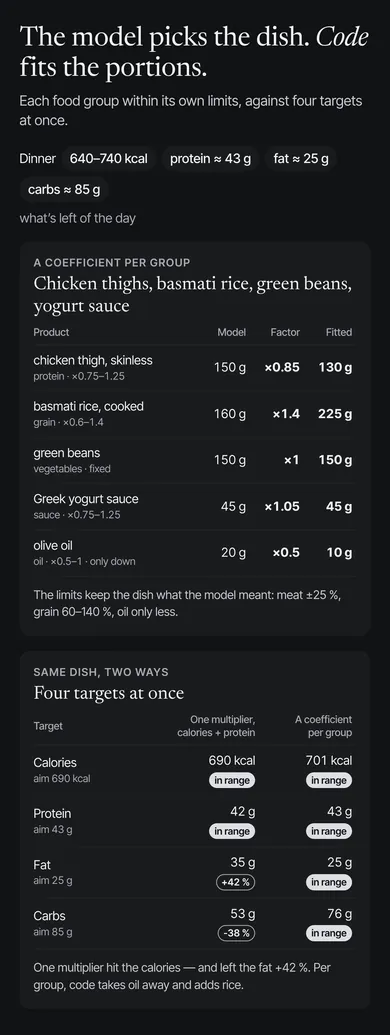
Fitting a dish to what's left of the day. The model picks the dish and its grams; code fits the portions. It finds one coefficient per food group — protein, grain, sauce, oil — each within its own limits, against calories, protein, fat and carbs at once. Meat moves by a quarter at most, grain between 60 and 140 %, oil only goes down: wider, and it stops being the dish the model meant.
Scale the whole dish — or each food group?
An earlier version looked only at calories and protein, and a menu with 42 % too much fat counted as fitted. Now the model is asked again only if no coefficients fit — so a better menu is also a cheaper one.
The interface
A tracker for food, training and progress, by day, week and month. I open it on my phone at the gym, between sets. Every value sits against its target range, and the target is a weekly average, so one day can swing. I kept it strict and plain on purpose: in a system about numbers, the interface should look trustworthy too.

Result
- One product database instead of three copies. The master copy lives with my recipe website, and the Mac keeps a read-only copy.
- One never-eat list. Code checks it in every door, so nothing on it can get through.
- Ratings that travel. A quiet 👍 or 👎 under a dish, from the chat or the bot, is seen by both doors the next time they plan. There's no reminder and no obligation.
- A week that knows what I ate. The bot balances the week against my diary, not just against its own plan.
- One edit, two readers. A change to the menu rules reaches the Hedgehog and the bot at once, without a restart.
- From menu to cart. The bot fills a Rohlík cart from the menu.
- My own tools. On my Mac, I now mostly use apps I built for myself.
Reflection
The skill here isn't writing code.
It's knowing what the team should do and saying it precisely — and that only comes from building for your own tasks.
Next time I'd start simpler: fewer use cases, test, add features only when needed. But building with agents is fast, and that changed what counts as waste: rebuilding is cheap, so trying again until it fit was worth it.
I also cut a step I'd planned: saving the dishes I liked to my recipe book. When it came to it, I didn't want a collection. I wanted a quick “liked it / not again” that shapes the next menu, and that was already built.